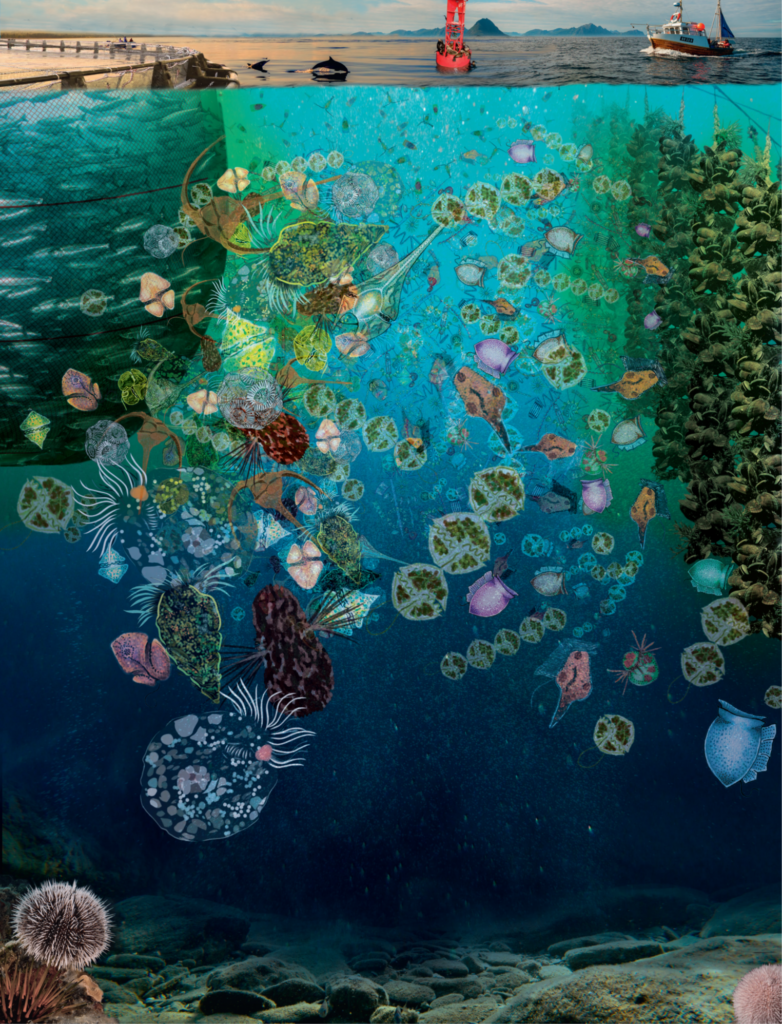

Mitra A, Cox N (2026) Mixoplankton and a new paradigm for ecology in coastal and marine waters. Zenodo. https://doi.org/10.5281/zenodo.18387815
Flynn KJ, Atkinson A, Beardall J, Berges JA, Boersma M, Brunet C, Calbet A, Caron DA, Dam HG, Glibert PM, Hansen PJ, Jin P, Lønborg C, Mayor DJ, Menden-Deuer S, Mock T, Mulholland MR, Needham DM, Polimene L, Poulton AJ, Robinson C, Rokitta SD, Rost B, Saiz E, Scanlan DJ, Schmidt K, Sherr E, Stoecker DK, Svensen C, Thiele S, Thingstad TF, Våge S (2025) More realistic plankton simulation models will improve projections of ocean ecosystem responses to global change. Nature Ecology & Evolution https://doi.org/10.1038/s41559-025-02788-3
Mitra A (2024) Importance of dynamics of acquired phototrophy amongst mixoplankton; a unique example of essential nutrient transmission in community ecology. Community Ecology. 25:307. https://doi.org/10.1007/s42974-024-00202-9
McManus G, Mitra A, Reguera B, Santoferrara L (2023) The Mixoplankton paradigm in plankton ecology. In: Harmful Algae News. Eds: Reguera B, Bresnan E. 73:15 https://doi.org/10.5281/zenodo.8406489
James MK, Powley HR, Mitra A, Torres R, Blackford JC (2023) Example simulation showing spatial and temporal variations in surface carbon biomass of plankton functional groups during a Spring bloom as shown by a 3D hydrodynamic-biogeochemical model (FVCOM-ERSEM), with and without integration of the mixoplankton paradigm. Zenodo. https://doi.org/10.5281/zenodo.7785539
Flynn KJ, Mitra A (2023) Feeding in mixoplankton enhances phototrophy increasing bloom-induced pH changes with ocean acidification, Journal of Plankton Research https://doi.org/10.1093/plankt/fbad030
Tillmann U, Mitra A, Flynn KJ, Larsson ME (2023) Mucus-Trap-Assisted Feeding Is a Common Strategy of the Small Mixoplanktonic Prorocentrum pervagatum and P. cordatum (Prorocentrales, Dinophyceae). Microorganisms 11:1730. https://doi.org/10.3390/microorganisms11071730
Mitra A, Flynn KJ, Stoecker DK, Raven JA (2023) Trait trade-offs in phagotrophic microalgae: the mixoplankton conundrum. European Journal of Phycology DOI: 10.1080/09670262.2023.2216259
Mitra A, Flynn KJ (2023) Low rates of bacterivory enhances phototrophy and competitive advantage for mixoplankton growing in oligotrophic waters. Scientific Reports 13:6900 doi: 10.1038/s41598-023-33962-x
Flynn KJ, Mitra A, Wilson WH, et al. (2022) ‘Boom‐and‐busted’ dynamics of phytoplankton–virus interactions explain the paradox of the plankton. New Phytol 234:990-1002. doi.org/10.1111/nph.18042
Anschütz A-A, Flynn KJ, Mitra A (2022) Acquired Phototrophy and Its Implications for Bloom Dynamics of the Teleaulax-Mesodinium-Dinophysis-Complex. Front. Mar. Sci. 8:799358. doi: 10.3389/fmars.2021.799358
Glibert PM, Mitra A (2022) From webs, loops, shunts, and pumps to microbial multitasking: Evolving concepts of marine microbial ecology, the mixoplankton paradigm, and implications for a future ocean. Limnology and Oceanography. doi.org/10.1002/lno.12018
Flynn, K. J., Speirs, D. C., Heath, M. R. and Mitra, A. 2021. Subtle differences in the representation of consumer dynamics have large effects in marine food web models. Frontiers in Marine Science 8, article number: 638892. doi.org/10.3389/fmars.2021.638892
Leles SG, Bruggeman J, Polimene L, Blackford J, Flynn KJ, Mitra A (2021) Differences in physiology explain succession of mixoplankton functional types and affect carbon fluxes in temperate seas. Progress in Oceanography 190:102481 https://doi.org/10.1016/j.pocean.2020.102481
Flynn, K. J., Kimmance, S. A., Clark, D. R., Mitra, A., Polimene, L. and Wilson, W. H. 2021. Modelling the effects of traits and abiotic factors on viral lysis in phytoplankton. Frontiers in Marine Science 8, article number: 667184. doi.org/10.3389/fmars.2021.667184
Glibert PM, Beusen AHW, Bouwman AF, Burkholder JM, Flynn KJ, Heil CA, Li M, Lin C-H, Madden CJ, Mitra A, Nardin W, Silsbe G, Song Y, Zhang F (2020) Multifaceted climatic change and nutrient effects on harmful algae require multifaceted models. In: Botana, L. M., Louzao, M. C. and Vilarino, N. eds. Climate Change and Marine and Freshwater Toxins, 2nd Edition. De Gruyter, pp. 473-518. https://doi.org/10.1515/9783110625738-012
Anschütz AA, Flynn KJ (2020) Niche separation between different functional types of mixoplankton: results from NPZ-style N-based model simulations. Marine Biology, 167: 1-21 https://doi.org/10.1007/s00227-019-3612-3
Schneider LK, Flynn KJ, Herman PMJ, Troost TA, Stolte W (2020) Exploring the Trophic Spectrum: Placing Mixoplankton Into Marine Protist Communities of the Southern North Sea. Frontiers in Marine Science 7:586915 https://doi.org/10.3389/fmars.2020.586915
Leles SG, Polimene L, Bruggeman J, Blackford J, Ciavatta S, Mitra A, Flynn KJ (2018) Modelling mixotrophic functional diversity and implications for ecosystem function. J. Plankton Res., 40: 627-642 https://doi.org/10.1093/plankt/fby044
Lin C-H, Flynn KJ, Mitra A, Glibert PM (2018) Simulating Effects of Variable Stoichiometry and Temperature on Mixotrophy in the Harmful Dinoflagellate Karlodinium veneficum. Front. Mar. Sci. 5: 320 doi:10.3389/fmars.2018.00320
Ghyoot C, Lancelot C, Flynn KJ, Mitra A, Gypens N (2017) Introducing mixotrophy into a biogeochemical model describing an eutrophied coastal ecosystem: The Southern North Sea. Prog. Oceanogr. 157: 1-11 http://dx.doi.org/10.1016/j.pocean.2017.08.002
Mitra A, Flynn KJ, Tillmann U, Raven JA, Caron D, Stoecker DK, Not F, Hansen PJ, Hallegraeff G, Sanders R, Wilken S, McManus G, Johnson M, Pitta P, Våge S, Berge T, Calbet A, Thingstad F, Jeong HJ, Burkholder J, Glibert PM, Granéli E, Lundgren V (2016) Defining planktonic protist functional groups on mechanisms for energy and nutrient acquisition; incorporation of diverse mixotrophic strategies. Protist 167: 106-120 https://doi.org/10.1016/j.protis.2016.01.003
Mitra A, Flynn KJ, Burkholder JM, Berge T, Calbet A, Raven JA, Granéli E, Glibert PM, Hansen PJ, Stoecker DK, Thingstad F, Tillmann U, Våge S, Wilken S, Zubkov MV (2014). The role of mixotrophic protists in the biological carbon pump. Biogeosciences 11: 995-1005 doi:10.5194/bg-11-995-2014
Mitra A, Flynn KJ (2010) Modelling mixotrophy in Harmful Algal Blooms; more or less the sum of the parts? J. Mar. Sys. 83: 158-169 https://doi.org/10.1016/j.jmarsys.2010.04.006
Flynn KJ, Mitra A (2009) Building the “perfect beast”: modelling mixotrophic plankton. J. Plankton Res. 31: 965-992 https://doi.org/10.1093/plankt/fbp044